The Shadow Allies Behind the Iran-US-Israel War
Iran has endured major challenges over the past several decades, including eight years of war with Iraq, prolonged political and diplomatic isolation, international sanctions, assassinations, economic hardship, and periods of domestic unrest.
Despite these pressures, Iran has continued to pursue an active regional and international foreign policy. This has included supporting allied proxy groups across the Middle East through the provision of funding, weapons, military training, and political backing. Iran has also been accused by its regional rivals and Western governments of interfering in the internal affairs of neighbouring states, supporting destabilising activities, and conducting intelligence and covert operations beyond its borders.
At the same time, Iran has maintained close strategic relationships with countries such as Russia, China, and North Korea, seeking to counterbalance Western pressure and reduce the impact of international isolation. Whether viewed as strategic resilience or regional expansionism, Iran’s ability to maintain and project influence under sustained pressure has been a defining feature of its foreign policy for decades.
The Hidden Hand
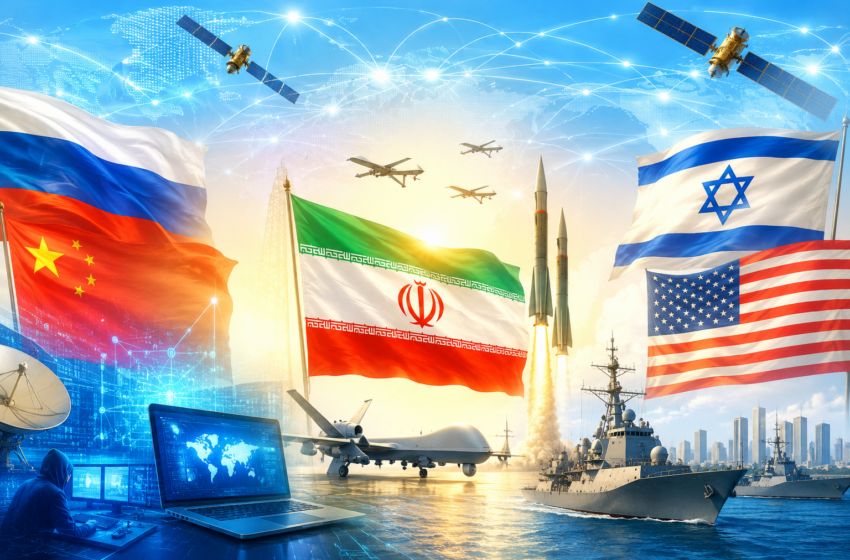
The recent war involving Iran, Israel, and the United States demonstrated that contemporary warfare is increasingly shaped by intelligence-sharing, cyber warfare, satellite surveillance, electronic warfare, and strategic geopolitical alliances. One of the most debated and strategically significant aspects of the war was the alleged role of Russia, China, and other foreign actors in supporting Iran with intelligence and cyber capabilities during attacks against Israeli targets and U.S. military bases in the Gulf region.
Although neither Russia nor China officially entered the war militarily, multiple intelligence leaks, strategic assessments, and media reports suggested that both countries provided indirect support to Iran through cyber cooperation, satellite intelligence, navigation systems, electronic warfare expertise, and strategic coordination. If accurate, these developments mark a significant transformation in global geopolitics and the nature of proxy warfare in the twenty-first century.
Russia has already lost one of its most important strategic footholds in the Middle East with the collapse of its position in Syria, which had long served as a key platform for projecting influence across the region and parts of Africa. At the same time, Russia has been heavily engaged in the war in Ukraine, which has consumed significant military, economic, and political resources. Given these setbacks, Moscow can ill afford to lose one of its strongest remaining regional partners, Iran.
From a strategic perspective, supporting Iran against pressure from the United States and Israel provides Russia with an opportunity to challenge its adversaries indirectly. Russia has an interest in strengthening Iran’s defensive and intelligence capabilities, as doing so helps preserve a regional ally while complicating U.S. and Israeli strategic objectives.
Whether through diplomatic backing, intelligence cooperation, military technology, or other forms of assistance, Russia has strong incentives to ensure that Iran remains a capable and influential actor in the region.
The Emergence of a New Strategic Bloc
Over the past decade, Iran, Russia, and China have gradually moved closer together due to shared opposition to American global influence. Each country has its own motivations, but all three increasingly see cooperation as beneficial against what they perceive as Western political, economic, and military dominance.
Iran has long faced sanctions and military pressure from the United States and Israel. Russia has been deeply isolated by the West following the Ukraine war, while China has entered an era of intensifying competition with Washington over technology, trade, and global influence. These shared pressures helped create an informal strategic alignment between Moscow, Beijing, and Tehran.
The Iran-Israel war therefore became more than a regional war. It evolved into a geopolitical testing ground where rival global blocs indirectly confronted one another without entering into direct superpower warfare.
Russia’s Alleged Intelligence and Military Assistance
Reports from Western intelligence-linked media outlets suggested that Russia played a significant role in enhancing Iran’s battlefield awareness during the conflict. Moscow allegedly supplied satellite imagery, reconnaissance data, and intelligence concerning U.S. naval deployments and military bases across the Gulf region.
This support may have dramatically improved Iran’s ability to coordinate missile, and drone strikes with greater accuracy. Iranian attacks appeared increasingly sophisticated compared to previous years, particularly in terms of synchronised drone swarms, missile trajectories, and target selection. Such operational improvements may have been impossible without external intelligence support.
Russia also reportedly shared electronic warfare expertise with Iran. Electronic warfare includes the disruption of enemy radar systems, communications, GPS guidance, and battlefield coordination networks. Iran has invested heavily in this field for years, but Russian experience from war in Ukraine and Syria likely accelerated Iranian capabilities.
Another critical area involved cyber warfare cooperation. Russian-linked cyber actors were accused of assisting Iranian cyber operations targeting Israeli infrastructure, communication systems, transportation networks, and financial sectors. Some intelligence assessments suggested Russian cyber specialists helped Iran bypass certain Israeli cybersecurity systems or provided operational knowledge gained from Russia’s extensive cyber campaigns against Western states. From Moscow’s perspective, supporting Iran indirectly served several strategic objectives.
First, it diverted American military attention away from Ukraine. As Washington shifted diplomatic, military, and intelligence resources toward the Middle East, Russia gained breathing space in Eastern Europe.
Second, instability in the Gulf region increased global energy prices, indirectly benefiting the Russian economy, which relies heavily on oil and gas exports.
Third, Russia aimed to weaken American credibility by demonstrating that U.S. allies and military installations could still be threatened despite advanced American defences.
Finally, Moscow likely viewed Iran as an increasingly important strategic partner in constructing a multipolar international order designed to challenge Western dominance.
China’s Role: Quiet but Technologically Significant
Unlike Russia, China adopted a more cautious and less visible role during the conflict. Beijing avoided direct military rhetoric and publicly called for restraint and diplomacy. However, several strategic assessments suggested that China may have provided Iran with important technological and intelligence support behind the scenes.
One of the most significant alleged contributions involved China’s BeiDou satellite navigation system.
BeiDou serves as China’s alternative to the American GPS system and has become increasingly important for military applications. There are strong reports that Iranian missile and drone systems may have used BeiDou guidance support to improve targeting precision during strikes against Israeli positions and U.S. military assets in the Gulf.
China was also accused of providing dual-use technologies to Iran. Dual-use technologies are systems that can serve both civilian and military purposes, including surveillance equipment, satellite imaging tools, radar systems, artificial intelligence software, and cyber technologies.
These technologies may have enhanced Iran’s:
- Battlefield Surveillance
- Drone Coordination
- Missile Guidance Systems
- Electronic Interception Capabilities
- Cyber Defence and Offensive Operations
Several Chinese companies reportedly faced scrutiny and sanctions from Western governments for allegedly supplying technologies linked to Iranian military modernisation.
China’s approach reflected its broader geopolitical strategy. Beijing generally prefers indirect influence through technology, infrastructure, trade, and intelligence cooperation rather than direct military confrontation. Supporting Iran quietly allowed China to challenge American influence while avoiding the risks of open military involvement.
China also has strong economic interests in the Middle East, particularly regarding energy security. Iran remains strategically important to Beijing as a major energy supplier and as part of China’s Belt and Road Initiative. A weakened or isolated Iran could threaten China’s long-term regional ambitions.
The Gulf Region and U.S. Military Bases
Another major aspect of the war involved attacks or threats against American military bases in the Gulf. Iran has long viewed U.S. military installations in countries such as Bahrain, Qatar, Kuwait, Iraq, and the United Arab Emirates as central components of American regional power projection.
Reports indicated that Iran attempted to improve its targeting capabilities against these bases using externally supplied intelligence and satellite support. This represented a dangerous escalation because attacks on U.S. forces risk triggering direct American retaliation. The Gulf region’s strategic importance stems largely from energy infrastructure and maritime trade routes, particularly the Strait of Hormuz. Any conflict threatening these areas immediately affects global oil prices, international shipping, and economic stability.
By allegedly assisting Iran with intelligence and cyber capabilities, Russia and China may have sought to increase strategic pressure on the United States while avoiding direct military confrontation.
Proxy Warfare and Strategic Ambiguity
The conflict demonstrated the growing importance of proxy warfare and strategic ambiguity in international politics. Instead of direct superpower confrontation, major powers increasingly support regional allies indirectly through:
- Intelligence Sharing
- Cyber Operations
- Arms Transfers
- Satellite Support
- Economic Assistance
- Diplomatic Protection
This allows countries like Russia and China to weaken adversaries without crossing the threshold into full-scale war. Strategic ambiguity also provides plausible deniability. Even if evidence suggests foreign involvement, the absence of official confirmation allows states to deny direct participation while still benefiting strategically from the conflict’s outcomes.
This model of warfare is likely to become more common in future geopolitical confrontations.
Conclusion
The Iran-Israel war represented far more than a traditional regional confrontation. It exposed the emergence of a new era of warfare shaped by cyber operations, intelligence networks, satellite systems, and global geopolitical rivalries.
Whether every allegation is ultimately confirmed or not, the broader strategic reality remains clear: the conflict highlighted the growing alignment between Iran, Russia, and China against Western influence and demonstrated how future wars will depend as much on data, satellites, drones and cyberspace as on conventional weapons.
The battlefield of the future is no longer limited to soldiers and missiles. It now includes algorithms, cyber networks, intelligence fusion, satellite surveillance, and invisible digital warfare operating behind the scenes of every major geopolitical confrontation.



1 Comment
[…] Iran from losing this key ally. I explored this issue in greater detail in my previous article, “The Shadow Allies Behind the Iran-US-Israel War”. Hezbollah also enables Iran to operate abroad and is alleged to have links with drug cartels in […]
Comments are closed.