The Palestinian Identity: Acceptance or Rejection
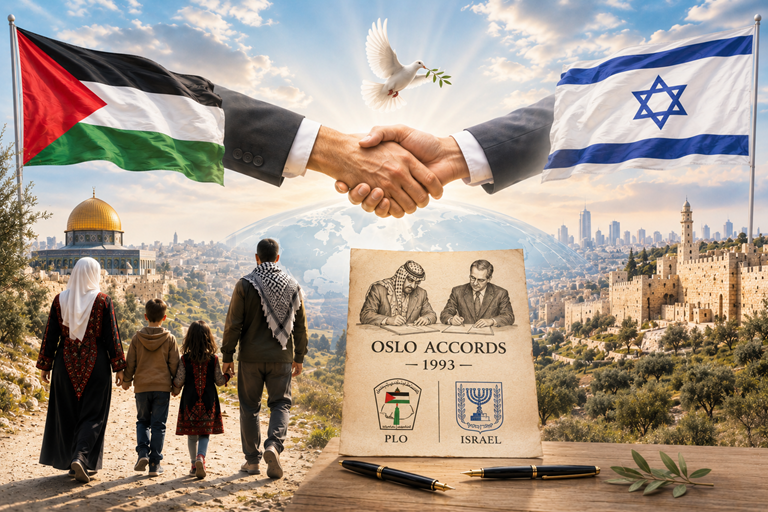
Palestinian identity has been widely debated in Israel, where different political groups within Israeli society have offered varied historical and geographical interpretations of it. However, there is no doubt that since Israel and the PLO (Palestine Liberation Organisation), led by Yasser Arafat, signed the Oslo Accord, the agreement opened the way for mutual recognition of each side’s identity and existence. It officially recognised the identity of Arab Muslims in the West Bank and Gaza Strip who had adopted a modern Palestinian identity.
There is no need to revisit the Arab conquest of the Holy Land (634–638 CE), a region once ruled by the separate kingdoms of Israel and Judah. Instead, the focus should be on more recent history, when Palestinian identity became part of the political and historical discussion because there was no documented modern national identity called “Palestinian” during this period. During the 400 years of Ottoman rule (1516–1917), no region was formally recognised as Palestine, nor did a distinct Palestinian national identity exist before the empire’s collapse.
Most historians trace the emergence of a distinct Palestinian national identity to the late nineteenth and early twentieth centuries, when the Arab Nahda promoted Arabic language and literature. From the 1880s onward, Zionist-led Jewish immigration increased, and many local Arabs increasingly saw themselves as defending their current homeland. In the early 20th century, Arab reform movements in the Holy Land under the Ottoman Caliphate sought to promote local Arab culture over the cultures of Syria, Egypt, and Lebanon but they did not name the culture.
The British Empire gave the territory a distinct identity through the British Mandate for Palestine (1920–1948), commonly referred to at the time as “Palestine.” After the First World War, Britain created the administrative unit of “Mandatory Palestine,” giving the name a concrete political and bureaucratic status. Passports, currency, and institutions carried the name “Palestine.” At the same time, the Balfour Declaration’s support for a Jewish national home, together with rising Jewish immigration, encouraged the Arab population to organise politically as “Palestinian Arabs.” This identity distinguished them from Syrians, Lebanese, and Arabs more broadly because their political struggle against British rule and Jewish settlement was tied to that specific territory.
Under British rule, newspapers used the term “Palestinian Arabs,” and Arab leadership increasingly organised around “Palestine” as a territorial homeland. Ironically, at the time, “Palestinian” could also refer to Jews living under the Mandate.
For example:
- The Palestine Post (now the Jerusalem Post)
- The Palestine Philharmonic Orchestra
- Palestine football teams included Jewish players
Although Palestinians are Arabs rather than a separate ethnic group, the term originally referred to residents of Mandatory Palestine as a whole. The creation of Israel and the first Arab-Israeli war transformed Palestinian identity. Around 700,000 Palestinian Arabs were displaced, including those who left their homes voluntarily at the request of Arab leaders who had entered the war against Israel. Refugee status, camp life, and statelessness rather than continued residence within a single political entity gave Palestinian identity a clearer and more distinct character: that of a people shaped by dispossession and the desire to return, even as many also held Jordanian or other citizenship while the West Bank was annexed by Jordan and Gaza was administered by Egypt from 1948 to 1967.
The establishment of the Palestine Liberation Organisation (PLO) in 1964, did not create Palestinian identity; rather, it gave political voice to an already emerging national movement.
After the 1967 Six-Day War, Palestinian nationalism grew stronger and became increasingly distinct from broader Arab nationalism. As noted earlier, the Oslo Accords signed by both parties gave legality to Palestinian identity and established full Palestinian self-rule in Area A and limited (administrative not security) in area B of the West Bank.
Some Israeli political blocs and their supporters reject the historical roots of Palestinian identity in the early twentieth century and deny its existence altogether, a view I believe misrepresents recent history. Most historians also reject the claim that Palestinians have existed unchanged for thousands of years. Modern Palestinian national identity instead emerged during the late Ottoman and British Mandate periods. Likewise, historians do not accept the Israeli claim that Palestinians were invented by Yasser Arafat after the six days war in 1967. Although the PLO was founded in 1964, evidence from newspapers, political organisations, memoirs, and correspondence shows that a distinct Palestinian identity had been developing for decades beforehand.
People often confuse ethnicity with identity. There is no evidence that a distinct ethnicity called “Palestinians” ever existed, nor was there a recognised area or state called “Palestine” before the British Mandate. The Mandate gave the name political significance and helped shape the identity of the local Arab community, which sought to distinguish itself from Syrians, Egyptians, and Lebanese.
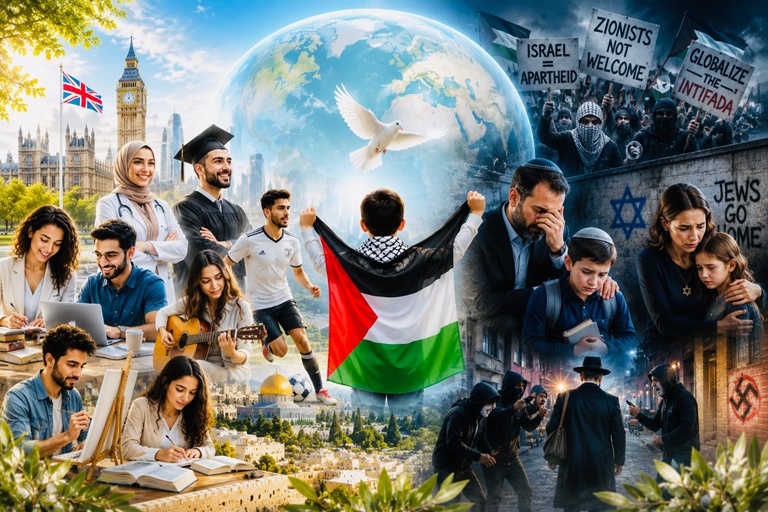
An Israeli friend recently told me that she would never accept Palestinian identity or existence because, in her view, Palestinians are hostile toward Israelis.
I believe this confuses identity with ideology. Identity acknowledges the existence of a person, group, or concept, even if it is relatively new; ideology, by contrast, refers to a set of beliefs, attitudes, and political views.
Israel has offered the Palestinian National Authority (PA) full Palestinian statehood several times, yet Palestinian leaders rejected these offers. If Palestinian identity does not exist, why would the Israeli government have offered statehood in the name of “Palestine”? Whether or not people accept this identity, “Palestinian” is now a legal and political identity recognised by Israel, the United States, the European Union, and the United Nations. We may reject ideologies that support violence against Israelis or call for Israel’s destruction, but we cannot deny Palestinian existence when Israel itself has recognised that identity. Personal opposition among Israelis cannot change that legal and political reality.
Majority Muslims around the world, as well as Palestinians in Gaza under Hamas rule, deny Israeli identity and the existence of the State of Israel in the Holy Land. I see this as a rejection of history, since history supports the Jewish people’s connection to their ancestral homeland, from which they were displaced thousands of years ago. In the same way, Israelis cannot deny the historical evidence that Palestinian identity developed from the late nineteenth to the mid-twentieth century, shaped by Ottoman reforms, the Arab cultural revival, British rule, modern Jewish immigration, and the political upheavals surrounding Israel’s establishment in 1948.
Modern Palestinian legal identity provides several recognised features and benefits, including territory, passports, representative institutions, political authority, and a national flag. The Palestinian passport is recognised by 157 of the 193 United Nations member states. Israel accepts it as a valid Palestinian travel document for border crossings, but not as proof of foreign citizenship or of an independent Palestinian state; for travel purposes, it must be used together with an Israeli-recognised Palestinian ID card. Some Israelis non-recognition of modern Palestinian identity does not change the fact that Palestinians exist and are recognised by a majority of UN member states worldwide.
Recognising an identity is distinct from recognising a state or ethnicity, just as ideology is separate from identity. One may reject hateful ideologies, but that does not justify denying the existence of Palestinians, whose population is estimated at roughly 5.9 to 6.1 million.