Be an Imam, Not a Security or War Expert
A British or in simple words, western Imam’s role is to lead congregational prayers, deliver Friday sermons, teach Muslim children about Islam, advise the Muslim community, and perform other religious duties. This broadly describes the responsibilities of Imams around the world, particularly in the west. Some Muslim Imams may also serve as scholars, depending on their knowledge, education, teaching experience, and authorisation from recognised religious institutions to use such title.
Most British Muslim students who aspire to become scholars undertake intensive Islamic studies, including Arabic, the Quran, Hadith, and Fiqh (Islamic jurisprudence). These courses usually last four to five years but may continue longer depending on further specialisation, such as becoming a mufti, an expert in Islamic law. However, only a small number of students reach that level. Out of hundreds of qualified young scholars, only a few become muftis after 10 to 15 years of experience and advanced study in Fiqh, Islamic law and interprets religious law.
Unfortunately, many British Muslim students do not continue to college or university after completing their GCSEs. Instead, they enrol in Islamic education centres, often higher-level madrasahs based in mosques, where they study intensively for about four to five years to become young scholars. Many then work in mosques, teaching Islam to children and leading prayers. However, when wages are insufficient, they often seek employment outside their religious communities and may end up in lower-level jobs because their formal education is limited to GCSE qualifications obtained years earlier. Many also marry in young age and have families to support, so they often need additional work beyond mosque-based teaching to meet their financial responsibilities.
Young Imams often begin by serving part-time, leading one or two of the five daily prayers. As they gain experience, they may gradually lead all five daily prayers and, eventually, be invited to lead large Friday congregations and deliver sermons. In the early stages, senior and more experienced scholars usually assign them sermon topics to prepare.
Once they have developed sufficient experience, they may choose their own topics and deliver Friday sermons to the Muslim community in mosques. Eventually, they may be appointed as full Imams, trusted to deliver Friday sermons independently.
However, their sermons are still regularly overseen by senior scholars to ensure they remain within accepted religious boundaries and are not driven by emotion or inappropriate rhetoric. In some mosques, Friday sermons are video recorded and occasionally broadcast live while Imams deliver them. Most sermons focus on encouraging good deeds, guiding the Muslim community away from wrongdoing, and explaining the importance of charity, religious duties, and rituals. At this level, they are well equipped to fulfil their religious duties effectively and understand their role in mosques clearly.
It is important to understand that Imams hold a highly respected position within Western, particularly British, Muslim communities. Many people trust them deeply and may accept their words as authoritative. Young Muslims listen to Imams more closely than to their own parents and give them significant influence within their families and communities. During sermons, no one dares to challenge Imams, and congregations listen to them closely and follow their guidance. This trust is rooted in the fact that many community members learned Islam from these same Imams from a young age, and the Imams lead important life events such as Nikah (wedding) ceremonies, births, and funerals. For many, Imams are closely connected to their religious identity, spiritual success, and hopes for the hereafter.
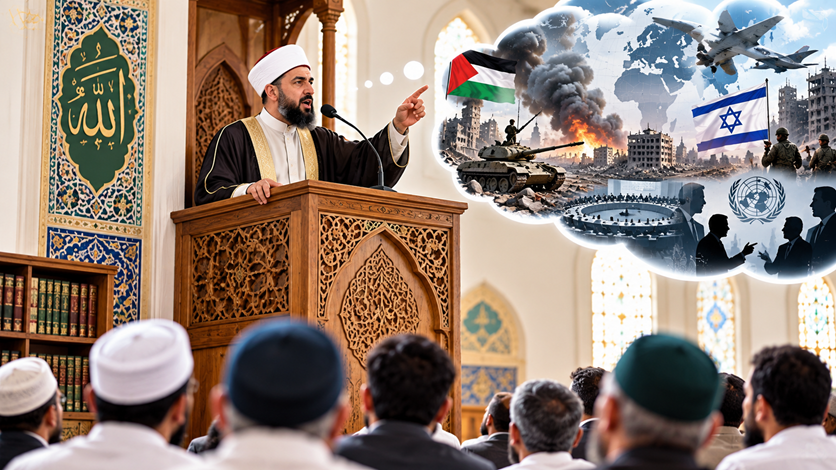
The problem for security and terrorism experts like us begins when we attend Friday prayers and hear the same Imams, whose role is to deliver sermons on religious matters and community issues, suddenly speak with great confidence about international politics, conflicts, wars, and security matters. At times, they appear more certain than trained experts, raising questions about the sources of their information, especially when it appears biased, misleading, inaccurate, or influenced by propaganda that spreads disinformation within Muslim communities.
Since the Israel- Gaza war began after the Hamas attacks of October 2023, we have observed Imams across the UK delivering regular political sermons in several mosques. These sermons always condemned Israel, criticised Jews, and expressed support for Palestinians fighting the Israel Defence Forces (IDF) in Gaza. From a security perspective, the concern is that such language may at times be understood as indirect support for Hamas, even if Hamas is not named explicitly.
Because Hamas is fully proscribed in the UK, openly supporting it can carry legal consequences; as a result, these Imams used terms such as “Palestinian fighters or Palestinian resistance” rather than referring directly to Hamas.
Many of them have not pursued modern higher education in colleges or universities and majority of them have not formally studied subjects such as terrorism, guerrilla warfare, security issues, collateral damage, military ethics, casualty ratios, international law, war crimes, or genocide. Instead of researching wars, conflicts, and security matters by consulting security specialists or discussing them with war experts, they reached conclusions too quickly and risked spreading terrorist-group narratives within Muslim communities in mosques across the UK.
When they studied Islam at a young age, they spent many years in Islamic institutions researching and learning the Quran, Hadith, and Fiqh in depth. They took great care to understand Islam correctly and teach it accurately to the Muslim ummah (community), avoiding the spread of incorrect religious information.
Yet when discussing international political and security issues, they always neglect the same standards of careful and thorough research before presenting their views to Muslim audience in mosques.
The irony is that when security experts, war specialists, and Middle East analysts present evidence-based information from the ground, some Imams immediately dismiss their views by questioning their personal faith. They may claim that, because these experts are Christians or Westerners, their analysis must be biased against Muslims. Yet when Muslim experts offer informed opinions, these Imams may also reject them as “puppets,” “traitors,” or “Western-paid agents.” In this way, they dismiss any view that challenges the biased or propaganda-based information they spread in mosques without proper verification.
The Qur’an establishes a clear principle: when news reaches you, especially from a potentially unreliable source, you should verify it before acting on it or sharing it.
The holy Quran says:
يَا أَيُّهَا الَّذِينَ آمَنُوا إِن جَاءَكُمْ فَاسِقٌ بِنَبَإٍ فَتَبَيَّنُوا أَن تُصِيبُوا قَوْمًا بِجَهَالَةٍ فَتُصْبِحُوا عَلَىٰ مَا فَعَلْتُمْ نَادِمِينَ
“O you who believe! If a wicked person brings you news, verify it, lest you harm people out of ignorance and then become regretful for what you have done.” (Qur’an 49:6)
The key word is فَتَبَيَّنُوا (fa-tabayyanu), investigate, verify, ascertain the truth.
This principle is especially relevant to news, social media, rumours, allegations, and political information: do not accept a claim simply because someone reports it. First, confirm that it is reliable.
We have also observed a troubling inconsistency. When Kurdish Muslims were killed by Turkish forces near the Syrian border, Western Imams remained silent. When Syrian forces killed fellow Muslims, they did not call for protests. When Iran’s Islamist regime massacred thousands of Iranians, it received zero attention in Friday sermons. More recently, when Sudanese Islamist militias and security forces killed thousands and were accused of using chemical weapons, majority of Imams again failed to condemn these atrocities.
Yet when Hamas called for global intifada, Western Imams responded quickly, urging Muslims to support Palestinians and fill Western capitals in protest.
In practice, this often appeared to mean support for Hamas rather than simply for Palestinians. They began cursing Jews and Israelis in sermons, while failing to apply the same religious duty to criticise Muslim states involved in massacres or genocide against their own citizens.
Islamic scholars hold a highly sensitive, respected, and responsible position within Islam. Their duty is to promote good and discourage wrongdoing in society, which requires careful research, deep analysis, accurate information, and balanced guidance for Muslim communities.
Their role should be to bridge religious and community divides between faiths and nations, not to deepen division or fuel hatred against any specific religion, community or country.
They are accountable to God, not to any political movement such as Muslim Brotherhood, and should serve as voices of divine guidance rather than channels for Hamas disinformation. They trained to become Imams and Islamic scholars, not security pundits, political analysts, war experts, or journalists. Different people study different fields, gain different experience, hold different responsibilities, and offer opinions according to their roles. Just as security and war experts do not challenge Imams on their religious duties, Imams should not dismiss or criticise expert security and war analysis built on years of study, professional experience, and ground-based knowledge.
If Imams wish to speak as security or war experts, they should devote years to studying war, conflict, and international politics, just as they spent years studying Islamic education. As they have travelled to different countries to preach Islam, they should also visit war-torn regions, examine facts from all sides, and present balanced, unbiased views to Muslim communities during Friday sermons.
At the very least, they should have condemned the atrocities committed by Hamas on 7 October and criticised the abduction of hundreds of Israelis, including children and Holocaust survivors. Such actions do not represent Islam.
Unfortunately, prayers for Hamas and sermons cursing Jews have given Hamas’s actions a religious endorsement. Imams should be careful about what they listen, see and spread to, because even one piece of false information can have lasting effects on an individual, group, or community. The Prophet Muhammad (PBUH) also warned Muslims not to trust every report they hear or spread information without first verifying it.
The Prophet ﷺ said:
كَفَى بِالْمَرْءِ كَذِبًا أَنْ يُحَدِّثَ بِكُلِّ مَا سَمِعَ
“It is enough falsehood for a person to relate everything he hears.” (Sahih Muslim, Introduction, Hadith 5)
This is remarkably applicable to the modern information warfare.
This does not mean everyone who repeats information is intentionally lying. Rather, passing on everything one hears can spread falsehood because the person has not separated truth from lie or propaganda.
Islam does not say:
“Believe everything you hear unless it is proven false.”
Rather, Qur’an 49:6 establishes the opposite principle when the source is suspect:
News → verification → establish credibility → then act/speak.
May Allah guide us all to verify what we hear and see before sharing it. Ameen.