Is Islam a Religion of Peace
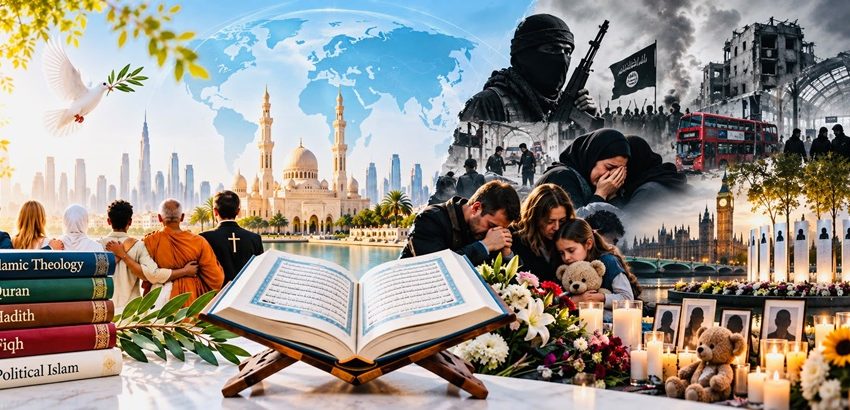
For decades, both Muslims and non-Muslims have frequently asked whether Islam is a religion of peace, and the question continues to provoke debate. Many non-Muslims view Islam as a religion of violence, while Muslims often respond defensively by comparing the scale of wars and violence over recent centuries. Before answering the central question, however, it is important to address a closely related one: What is religion?
To address this question, we must first understand religion. Although definitions vary, I define religion as a divine system of beliefs revealed by God, whom some regard as a supernatural power. This guidance is conveyed through chosen individuals known as prophets or messengers and preserved in sacred texts. The Torah, the Bible, and the Quran contain divine teachings and commandments that set out principles of right and wrong, what people should and should not do.
Muslim believe that Islam is a divinely revealed religion conveyed to the Prophet Muhammad through verses collected in the Holy Quran, while his teachings and interpretations are preserved in the Hadith. Like other religions, Islam provides rules, laws, commandments, and guidance on personal conduct, self-discipline, the treatment of others, and, in some matters, laws of wars. Islam is a trust (Amanah) entrusted by God to Muslims, not something any person can own.
As divine legislation belonging solely to God, it holds that only God ultimately judge Muslims in matters of religion. Muslims are not permitted to assume authority over religious law or judge others solely from a religious perspective. However, they may consult divine law for guidance in resolving particular matters.
At Islam’s emergence, Muslim society was largely understood as a collective. Today, however, Islam is practised worldwide and should be considered at both collective and individual levels. Muslim conduct should not be assessed solely through percentages, for example, the proportion of Muslims who follow the religion, commit violence, or embrace extremist interpretations, etc. Individual actions also matter because, in today’s global village, social media can record, amplify, and circulate a single act worldwide within seconds, leading people to scrutinise and judge it closely.
A person’s actions reveal their character and beliefs; when undertaken in the name of religion, however, they can also influence how the public perceives that religion. For example, if there are ongoing terrorism acts and violence in Pakistan by Islamists, the world would not focus on Islamists but on Pakistan and would describe it as “Pakistan is not a safe country.” In the same scenario, when Islamists use Quranic verses to commit acts of violence against non-Muslims, the world would not focus on Islamists but at Islam and Quran and would conclude as “Islam is a religion of violence.” Therefore, individuals’ actions carry out in the name of religion would impact on religion directly.
The following three case studies illustrate how actions committed in the name of religion can negatively affect perceptions of the religion as a whole.
Case Study 1:
A lady whose husband was murdered by British Islamist’s act of suicide terrorism in London underground in 2005. He was killed in the name of Islam by a Muslim terrorist who judged her husband an infidel and liable to be killed. She will not accept the concept of Islam is a religion of peace and no none can convince her because she lost her loved one in the name of religion. Islam will never be a religion of peace for her throughout her entire life.
Case Study 2:
Sri Lankan Hindu factory manager Priyantha Kumara was falsely accused of blasphemy by Muslim factory workers in Pakistan in 2021. A mob dragged him away, beat him with bricks and iron rods, and burned him alive while chanting, “Gustakh-e-Rasool ki Saza, Sar tan se Juda,” meaning, “The punishment for a blasphemer of the Prophet is decapitation.” His burned body was returned to his grieving family in Sri Lanka. His wife and children knew that their husband and father had been brutally murdered in the name of Islam by Pakistani Muslims. For them, Islam will never be perceived as a religion of peace, and no one may be able to persuade them otherwise.
Case Study 3:
In 2023, Hamas carried out terrorist attacks in Israel that killed more than three thousand Israelis. Women and girls were raped and murdered, children were killed alongside their families, and, in many cases, entire families were burned alive in their homes. These acts were committed by an Islamist group in the name of Islam, with perpetrators reciting Quranic verses while sexually assaulting and killing women and girls. Given these events, could anyone convince Israelis that Islam is a religion of peace?
Case Study 4:
After Jews were killed in Israel on 7 October 2023, Muslims, including young college and university students, gathered in London to celebrate the Hamas attacks, applaud the killings and rapes, and describe them as legitimate resistance. None of the imams representing Britain’s 2,000 mosques issued an official statement or held a press conference condemning the Hamas attacks; instead, many delivered Friday sermons supporting Hamas and cursing Jews. Some demonstrators also chanted, “Rape is resistance,” implying that the rape of Jewish women was a form of Palestinian resistance. In these circumstances, how could the UK’s Jewish community be expected to regard British Islam as a religion of peace?
Muslim Imams often welcome rising conversion rates in the Western world and emphasise that Islamist terrorist violence accounts for a smaller proportion of deaths than Western wars over the past century, which have killed millions. They either ignore or unknown to the facts that the Western wars of the past century, which killed millions, were not fought in the name of religion, nor did Hitler murder six million Jews in the name of Jesus or Christianity.
By contrast, Muslims continue to kill fellow Muslims and non-Muslims in the name of Islam worldwide in pursuit of Islamic supremacy and a global authoritarian system known as the “Islamic Caliphate.”
However, when asked about terrorist attacks committed by Muslims in the name of Islam, they often respond defensively:
- They are not true Muslims.
- They do not represent Islam.
- Islam leaves no room for extremism.
- Terrorism is not monopoly of Islam
They have failed to acknowledge that these four defensive claims do not fully reflect reality. Those who commit political violence in Islam’s name regard themselves as devout Muslims and their actions as expressions of their faith. Quranic verses and Hadith can be manipulated or distorted to indoctrinate individuals into Islamist terrorism, and Islamic texts continue to be invoked to justify political violence. Religious extremism exists within Islam’s theological framework, but it has been deliberately overlooked to preserve religious authority over ordinary Muslims and non-Muslims.
When Muslims say of Islamist terrorists, “They are not true Muslims,” they may be unwilling to confront the uncomfortable reality of fellow Muslims committing violence in Islam’s name. The issue is not simply whether their interpretation is true or false. The more difficult question is: are these people Muslims or not?
These are people who identify themselves as Muslims and use Islamic terminology, texts and religious arguments to justify their actions. Some even declare fellow Muslims to be kuffar (disbelievers) and claim that they deserve to be killed. We should therefore not become defensive by simply saying, “They are not Muslims,” or “Islam has nothing to do with terrorism.” That does not adequately address the problem. In fact, these extremists invoke Islamic texts, including the Quran and Hadith to construct a religious justification for violence against both Muslims and non-Muslims. Whether their interpretation is theologically legitimate is a separate question that must be examined seriously.
Muslims need to acknowledge at least three realities about Islamists:
- They identify themselves as Muslims and operate within an Islamic ideological framework.
- They use Islamic texts and concepts to justify their violence.
- Islamism, particularly its violent and extremist manifestations exist within the broader history of Islamic thought and cannot simply be dismissed by denying its Islamic vocabulary or references.
We should not respond defensively. Before we can develop effective solutions, we must honestly identify and acknowledge the problem. If there is a serious ideological disease affecting parts of our religious doctrine, we must be willing to diagnose it, understand how it developed, and confront the ideas that sustain it. We cannot cure a problem that we refuse to acknowledge exists.
In today’s global village, Islam is increasingly judged through the religious actions of individuals. It cannot be widely accepted as a religion of peace until Islamist violence is stopped, Islamist doctrine is challenged by Muslim theologians, and victims of Islamist terrorism are convinced that Islam is not inherently violent.
Until then, victims will not regard Islam as a religion of peace.