Terrorism Types and Ideologies
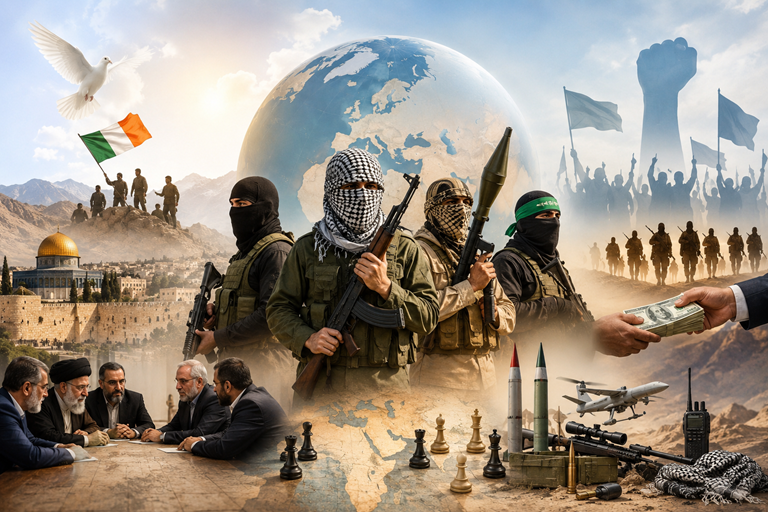
Many forms of terrorism and terrorist groups operate around the world. Some have existed for more than a century, others for several decades, and some are relatively new. Based on my study and research, I identify three active types of terrorism in the world.
- Offensive Terrorism
- Resistive Terrorism
- Supportive Terrorism
These types of terrorism differ in ideology and psychological impact. Some aim to create fear and tension among the public; others target military infrastructure, seek to weaken government authority, or disrupt economic systems. Determining which type operates in a particular region is difficult and requires close observation and research into local movements. Some organisations are supported or funded by governments, others by the public, and some survive through criminal activity. Each organisation has its own motives and agenda: some are religious, some are secular, and others are nationalist.
Some also have Marxist roots. Many organisations that emerged in the Middle East were shaped by nationalist or Marxist ideas. Groups supported or funded by Jordan, Egypt, Syria were largely nationalist however organisations supported by Qatar and Iran were religious. This raises the question of how three of the most well-known terrorist organisations differ from one another:
- IRA (Irish Republic Army): Nationalist
- Hamas: Religious cum Nationalist
- Taliban: Religious
- Hezbollah: Religious
A common feature of these organisations is their political role within the state. Each has, or has had, some level of involvement in the political system. Their agendas can be divided into two areas: domestic and cross-border. Within the state, they pursue political and social objectives, while across borders they use terrorism to seek international political advantage.
The question is whether these four organisations fit into the first category of terrorism listed above or into the second, third, or fourth. Some counter-terrorism experts place them in the third category, resistive terrorism, and often describe them as resistance movements and other place then in 1st category, which is offensive terrorism. Their actions have generally been directed against governments or forces they regard as occupying powers: the IRA against the UK government in Northern Ireland, Hamas and Hezbollah against the Israeli government, the Taliban were against Western forces in Afghanistan.
In my view, all four organisations can fall into more than one category, depending on their activities and the actions of the forces opposing them.
At different times, these resistance movements have shifted into offensive or defensive positions and carried out terrorist activities accordingly. They have also received support from governments seeking to advance their own political interests.
The IRA began as a terrorist group but has since become a broader movement with support among parts of the Irish population. Similarly, Hamas began as a single group but developed into a wider movement among Palestinians. The Afghan Taliban were initially supported by Pakistan but later gained backing from sections of the Afghan population opposed to Western forces and the Western-backed government, while Hezbollah, supported by Iran, gained support among Lebanese communities in southern Lebanon. There were two main Taliban groups: one fighting Western forces in Afghanistan and another operating against Pakistani forces in Pakistan. Both were use similar offensive tactics, including suicide bombing and their objectives were also the same. One seeks to impose Sharia law in Pakistan, while the other aims was to remove Western forces and then stablish the Sharia law in Afghanistan.
Hamas was established in 1982, at a time when Palestinians had experienced repeated setbacks in their resistance efforts and Arab governments had lost wars and territory to Israel. Unlike earlier resistance movements built mainly around nationalism, Hamas was formed on a religious basis. As those nationalist movements declined, many people placed their hopes in Hamas as an Islamic resistance movement. Because many Palestinians were nationalist or secular rather than deeply religious, Hamas also adopted a nationalist dimension and became a religious-nationalist resistance organisation. Hamas differs significantly from the Taliban in ideology, strength, and sources of support. Its ideology was influenced by the Ikhwan, or Muslim Brotherhood, which was founded in 1926.
The Ikhwan established branches in several countries, including Iraq, Yemen, Jordan, Syria, Egypt, and the British Palestine. After the creation of Israel, its Palestinian branch split into two: one in the West Bank, influenced by Jordanian Ikhwan, and another in the Gaza Strip, influenced by Egyptian Ikhwan. Around thirty years later, the Gaza-based branch created a new military organisation known as Hamas. Hamas was therefore connected to the Ikhwan ul Muslimoon, or Muslim Brotherhood, and was influenced by its ideology, including the ideas of Hasan Al Bana and Syed Qutb. Saudi Arabia has long opposed the Ikhwan, partly because of the movement’s alleged support for the group led by Juhayman al-Otaibi, which attacked the Holy Ka’bah in Makkah. This helps explain Saudi Arabia’s support for General Sisi in overthrowing Morsi’s Ikhwan-linked government in Egypt and its continuing opposition to Hamas because of its Ikhwan roots. Iran, as a rival of Saudi Arabia, has supported, funded, armed, and trained Hamas militants because Hamas opposes Saudi Arabia and Saudi Arabia opposes Hamas.
When Morsi’s government was overthrown by the Egyptian army, Qatar was one of the few countries to strongly condemn the move and oppose Saudi Arabia’s policy in Egypt. Qatar has consistently supported the Ikhwan, which is why several senior Hamas leaders have found shelter there. Qatar also rejected the Egyptian army’s actions against the Ikhwan, and its opposition to Saudi policy has contributed to tensions between Saudi Arabia and Qatar.
The Taliban’s ideology was later linked to Ikhwan-influenced thinking, which helps explain its support for Al Qaeda, whose ideology was shaped by Ikhwan and Qutb ideas.
In this view, Ikhwan ideology has influenced many well-known Islamist terrorist organisations and continues to spread, making it important for Muslim countries and leaders to educate their people about its threat. The culture of Islamist terrorism varies across regions and can sometimes differ sharply between organisations in different countries, although their ideological objectives often remain similar. For example:
- South Asian and Middle Eastern terrorist groups
- African and Western terrorist groups
- East Asian and Balkan-region terrorist groups
Each Islamist terrorist group has its own reasons, justifications, and motivations for carrying out terrorist actions. However, their broader ideological goals are often similar: to establish an Islamic caliphate or impose Sharia law in the territories they control. Groups such as Hamas, the Taliban, ISIS, Hezbollah, Boko Haram, and Al-Shabaab had pursued different motives and methods, but each has sought, at different points, to impose its own version of Islamic law in captured or controlled areas or countries.
The ultimate aim of these Islamist and nationalist organisations is often to establish control over the territories where they operate. Once they form a state or governing structure, they can expand their networks, operate more openly, and build relationships with countries that may have previously supported them in secret. For example, the IRA eventually abandoned armed struggle, entered formal politics, and contributed to the political system in Ireland. The Houthis still control much of Yemen, Hamas has governed Gaza, and Hezbollah has built a powerful state-like presence within Lebanon. Abu Julani, a prominent al-Qaeda-linked leader, has captured Syria and established a government that has gained recognition from many Arab and Western countries.