Iran: From Monarchy to Theocracy, A Cycle of Extremes
Summary:
Any serious analysis of the current conflict involving Iran must begin with an honest assessment of the nature of its ruling system. The Iranian regime has, over decades, embedded an ideological framework that merges state power with a rigid interpretation of political Islam. This has not only shaped domestic governance but also influenced Iran’s regional posture.
However, despite internal unrest and external pressure, the expectation of a rapid collapse of the Iranian regime is unrealistic. Power structures in Iran are deeply entrenched politically, militarily, and ideologically. Even senior intelligence assessments in the West suggest that any meaningful internal shift would take time rather than occur suddenly.
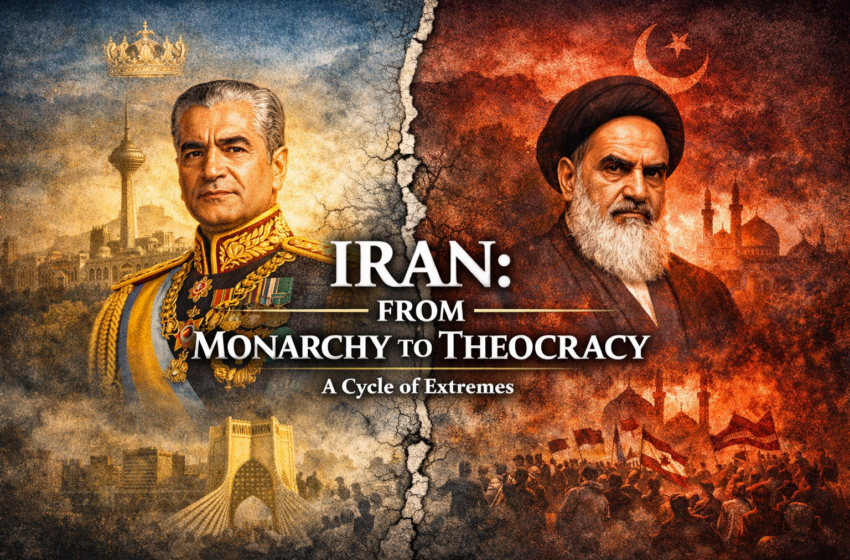
To understand this resilience, one must look at Iran’s modern political history. Over the past 50 to 80 years, Iran has experienced two sharply contrasting systems of governance. The first was the secular monarchy under Mohammad Reza Shah Pahlavi, which emphasised modernisation, Western alignment, and state-led reforms. The second is the current religious system established after the 1979 revolution under Ruhollah Khomeini, which positioned clerical authority at the centre of political power.
A Failure King of Iran:
The downfall of Mohammad Reza Shah Pahlavi in 1979 was not the result of a single failure, but rather a combination of political, social, economic, and cultural policies that alienated large segments of Iranian society. His rule, though marked by modernisation and economic growth, ultimately created deep dissatisfaction that led to the Iranian Revolution and his overthrow.
One of the most significant reasons for the Shah’s failure was his authoritarian style of governance. Although Iran had a constitution, the Shah increasingly concentrated power in his own hands, limiting political freedom and suppressing opposition. Political parties were weakened, and dissent was often crushed by the secret police, SAVAK. This repression created widespread fear and resentment among intellectuals, students, and political activists. Over time, even moderate critics of the regime were silenced, leaving no peaceful outlet for opposition, which contributed to revolutionary anger.
Another major factor was the Shah’s aggressive modernisation policies, particularly the “White Revolution.” While these reforms aimed to modernise Iran through land redistribution, industrialisation, and women’s rights, they disrupted traditional social structures. Many religious leaders and conservative groups viewed these changes as an attack on Islamic values and Iranian identity. The Shah’s attempts to reduce the influence of the clergy only strengthened opposition figures like Ruhollah Khomeini, who mobilised religious sentiment against the monarchy.
Closely linked to this was the Shah’s strong alignment with Western powers, particularly the United States. His reliance on Western political and military support led many Iranians to view him as a puppet of foreign interests rather than a nationalist leader. Policies such as granting legal immunity to foreign personnel and adopting Western cultural practices further alienated both religious and nationalist groups. This perception of foreign domination became a powerful rallying point for revolutionaries.
Economic issues also played a crucial role. Although Iran experienced rapid growth due to oil revenues, wealth distribution was highly unequal. Much of the economic benefit went to the elite and those connected to the royal court, while ordinary citizens faced inflation, unemployment, and rising living costs. When economic conditions worsened in the late 1970s, public frustration intensified. The gap between rich and poor, combined with corruption and perceived extravagance of the royal family, deepened public anger.
Furthermore, the Shah failed to build a broad base of political support. By sidelining both religious leaders and traditional economic groups such as bazaar merchants, he weakened potential allies. His creation of a one-party system further alienated the population, as it forced political conformity and eliminated pluralism.
The fall of the Shah was not accidental. It was driven by widespread dissatisfaction ranging from political repression and lack of democratic participation to economic disparity and cultural alienation. Many Iranians felt disconnected from a system that appeared increasingly centralised and unresponsive. In this environment, Khomeini emerged not necessarily as the perfect choice, but as the most organised and credible opposition figure capable of mobilising mass support. His leadership filled a political vacuum at a critical moment.
Finally, the Shah underestimated the strength and unity of the opposition. Diverse groups, including Islamists, liberals, and leftists, united against him despite their ideological differences. As protests grew in 1978, the regime’s inconsistent response alternating between repression and concessions, made the Shah appear weak and indecisive. This emboldened protestors and accelerated the collapse of his rule.
In conclusion, the Shah’s downfall was the result of interconnected failures: authoritarian rule, cultural insensitivity, economic inequality, and dependence on foreign powers. These policies eroded his legitimacy and united a broad coalition of opponents. Ultimately, the Iranian people rejected his rule, leading to the revolution of 1979 and the end of the Pahlavi monarchy.
Barbaric Islamic Regime of Iran:
The establishment of the Islamic Republic of Iran in 1979 marked the rise of a system rooted in political Islam, where religious authority became inseparable from state power. While its founders claimed to create a just and moral society, the reality over the decades has revealed a system that has significantly constrained the rights, freedoms, and potential of the Iranian people. The fusion of religion and politics under clerical rule has not only limited democratic development but has also led to widespread repression and violence against its own citizens.
At the core of the Islamic Republic is the doctrine of Velayat-e Faqih (Guardianship of the Islamic Jurist), which places ultimate authority in the hands of an unelected Supreme Leader. This system fundamentally undermines democratic governance, as elected institutions operate under the shadow of clerical control. As a result, political pluralism is severely restricted, and dissent is often treated as a threat to the state rather than a legitimate expression of public will. Independent political parties, free media, and civil society have been systematically weakened or suppressed.
One of the most serious consequences of this system has been the persistent violation of human rights. Over the years, Iranian authorities have responded to protests and dissent with extreme force. Recent reports indicate that thousands of protesters have been killed during nationwide demonstrations, with estimates ranging from over 3,000 to potentially tens of thousands in some crackdowns. Human Rights Watch and other organisations have documented mass killings, arbitrary arrests, torture, and enforced disappearances as part of a broader strategy to silence opposition. The use of lethal force against civilians, including children, reflects a pattern of governance that prioritises regime survival over the lives of its citizens.
In addition to physical repression, the Islamic regime has curtailed fundamental freedoms such as expression, assembly, and religion. Strict laws regulate personal behaviour, particularly affecting women, who face compulsory dress codes and legal inequalities. Ethnic and religious minorities have also faced discrimination and marginalisation. According to international human rights reports, these restrictions are enforced through surveillance, censorship, and intimidation, creating an environment of fear and control.
Economically, the ideological nature of the regime has also hindered Iran’s development. Instead of focusing solely on national prosperity, significant resources have been directed toward ideological and geopolitical ambitions. Combined with corruption, mismanagement, and international isolation, this has resulted in high inflation, unemployment, and declining living standards for ordinary Iranians.
Studies suggest that the 1979 revolution and its aftermath caused long-term damage to Iran’s economic growth and institutional quality.
Moreover, the regime’s reliance on fear and coercion has created a deep disconnect between the state and society. Mass arrests reportedly exceeding tens of thousands in recent protests and the use of forced confessions and death sentences highlight a justice system that lacks transparency and fairness. Such practices erode public trust and fuel cycles of unrest, as citizens increasingly demand accountability and reform.
In conclusion, the Islamic Republic of Iran, as a system of political Islam, has profoundly impacted the country’s trajectory. While it sought to establish a moral and independent state, it has instead produced authoritarian governance, systemic repression, and widespread human suffering. The suppression of rights, combined with economic and social challenges, has prevented many Iranians from achieving their full potential. Ultimately, the experience of the past decades suggests that the fusion of absolute religious authority with political power has come at a significant cost to the Iranian people.
Is Prince Reza Pahlavi a Suitable Candidate?
The question of whether Reza Pahlavi is a suitable figure to lead Iran remains highly contested among analysts, opposition groups, and Iranians themselves. While he is often presented as a symbolic alternative to the Islamic Republic, strong criticisms exist regarding his leadership capacity, political vision, and ability to unify Iran’s deeply diverse society.
One of the central criticisms of Pahlavi is his lack of effective leadership experience and operational presence inside Iran. Having lived in exile for nearly five decades, he has had limited direct engagement with the realities faced by ordinary Iranians. He also lacks the “ground network” necessary to mobilise meaningful political change within the country, and some former officials have even described him as ineffective in practical political organisation. This absence of internal infrastructure raises serious questions about his ability to transition from a symbolic figure into a functioning national leader.
Moreover, the Iranian opposition remains highly fragmented, and Pahlavi has struggled to unify its competing factions. Iran’s opposition includes monarchists, republicans, ethnic minority movements, secular activists, and religious moderates, each with different visions for the country’s future. Analysts note that no single leadership structure has emerged to coordinate these groups effectively. In fact, Pahlavi has failed to build a broad, inclusive coalition and instead relies heavily on loyalist supporters, which further deepens divisions rather than resolving them. In some cases, his supporters have been accused of alienating other opposition voices, treating dissenters as obstacles rather than partners.
Another major concern is the absence of a clear and widely accepted political framework for a post-Islamic Republic Iran. While Pahlavi has proposed transitional ideas, and these plans remain vague and overly dependent on assumptions that the population will rally behind him after regime change.
There is little clarity on how he would address complex issues such as ethnic autonomy, religious diversity, or institutional reform. Without a detailed and inclusive roadmap, many fear that a power vacuum could emerge, leading to instability rather than democratic transition.
In addition, Pahlavi’s political positioning has drawn criticism from both religious and secular perspectives. Some religious Iranians remain wary of his strongly secular stance, perceiving it as dismissive of Islam’s role in Iranian society. At the same time, secular critics question whether his association with monarchy represents a genuine break from authoritarian traditions or a potential return to them. His reluctance to fully distance himself from monarchist ambitions has been viewed by some as a “red flag” that could undermine democratic credibility.
Finally, Pahlavi has yet to demonstrate the ability to reconcile Iran’s ideological divides between religious and secular populations, as well as among various ethnic and political groups. Without a unifying vision that accommodates these differences, his leadership risks being seen as divisive rather than integrative. While Reza Pahlavi remains a prominent opposition figure, significant concerns persist about his leadership effectiveness, lack of a comprehensive framework, and inability to unite Iran’s diverse society. These challenges continue to fuel debate over whether he can realistically serve as a viable leader for Iran’s future.
The historical trajectory highlights a recurring challenge in Iran: the absence of a unifying, inclusive political alternative capable of bridging ideological divides. Without such a framework, the risk remains that any future transition could once again swing between extremes, rather than leading to stable and representative governance.
How Could future Leader of Iranian Nation Be?
A sustainable future for Iran is unlikely to emerge from rigid ideological rule or a return to dynastic leadership, but rather from a credible, moderate voice rooted in the realities of Iranian society. The country’s diversity religious, secular, ethnic, and cultural requires leadership capable of balance, inclusion, and pragmatism. A strong moderate figure, or coalition, could provide a unifying alternative by prioritising national cohesion over ideological dominance.
Iran’s modern history shows the risks of concentrating power in narrow frameworks, whether under clerical authority or monarchic legacy. Neither model has successfully represented the full spectrum of Iranian society. The current system has been widely criticised for limiting freedoms and excluding dissenting voices, while monarchist alternatives remain divisive and lack broad consensus among Iranians. As a result, many citizens seek a path that avoids both extremes.
A moderate leadership approach would aim to bridge the divide between secular and religious communities. Rather than suppressing one in favour of the other, it would recognise religion as part of Iran’s social fabric while ensuring that governance remains accountable, pluralistic, and rights-based. This balance is essential for long-term stability, as exclusion of any major group risks perpetuating conflict.
Equally important is the commitment to fundamental human rights. A credible moderate leadership must guarantee freedom of expression, belief, and assembly, while protecting minorities, ethnic, religious, and political from discrimination. By embedding these principles into law and governance, Iran could move toward a more just and inclusive system. Ultimately, only a unifying and moderate vision free from rigid ideology or inherited authority can genuinely represent Iran’s diverse nation and guide it toward stability and progress.
References:
- Background and causes of the Iranian Revolution
- Kapuscinski, Shah of Shahs (1985).
- At Least 3,428 Protesters Killed in Iran: Serious Risk of Protester Executions
- Hokumat-e Islami: Velayat-e faqih (book by Khomeini) #Why has Islamic Government not been established?
- Iran growing evidence of countrywide massacres
- Revolutions as Structural Breaks: The Long-Term Economic and Institutional Consequences of the 1979 Iranian Revolution
- Iran’s Machinery of Repression Escalates: Arbitrary Arrests, Torture, Enforced Disappearances, and Death Sentences After Protest Massacre
- Iranian exile Factions vie for US Leaders’ blessing to lead Iran
- The Fracture of Opposition to the Islamic Regime
- What’s Wrong with Iran’s Opposition?
- Crown prince Reza Pahlavi on US military intervention in Iran
- Who could lead Iran after Khamenei’s Death?